
A Strange Sound on Commercial Street
Shortly after noon on January 15, 1919, Boston’s North End was going about an ordinary winter day.
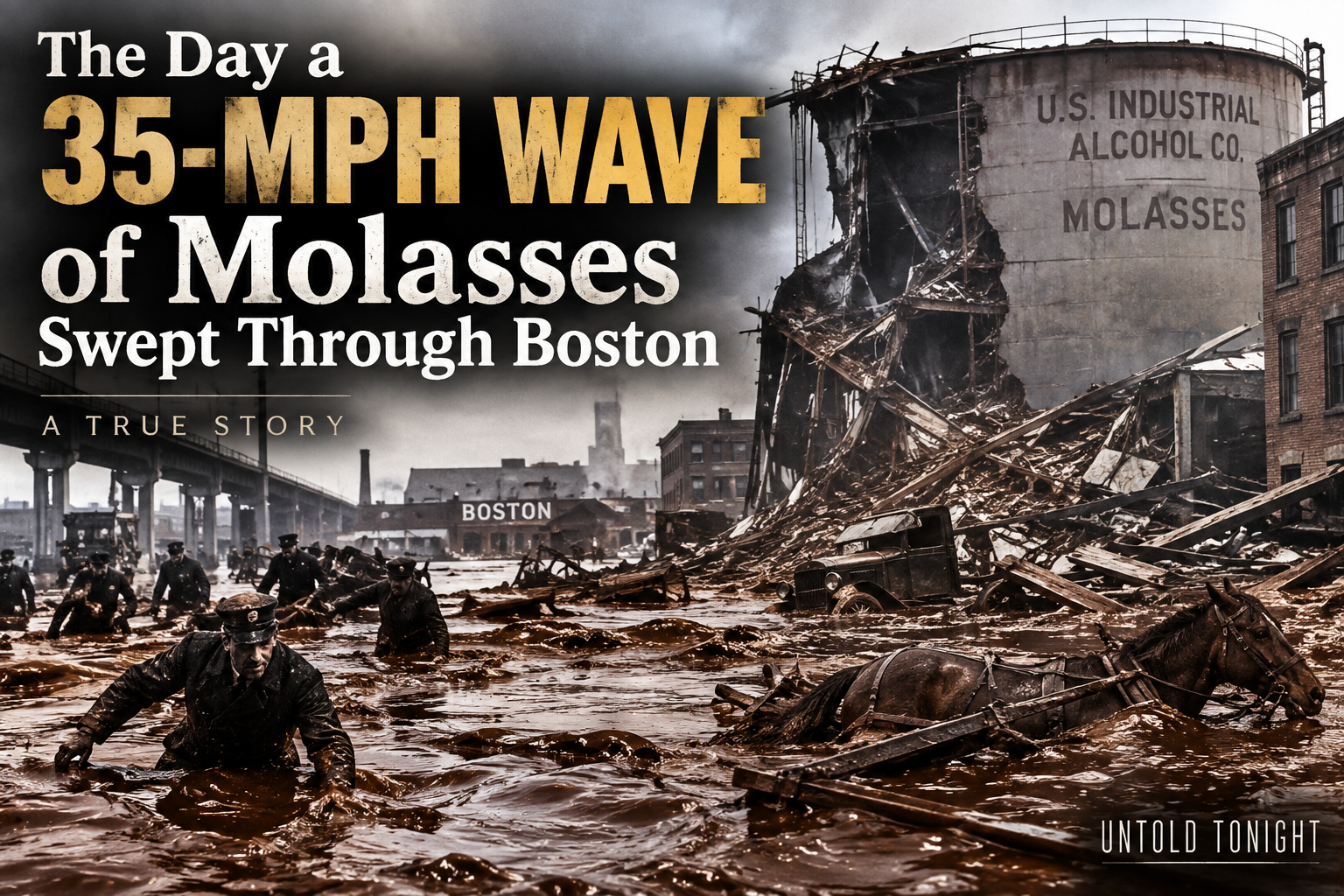
Workers stopped for lunch. Wagons and trucks moved along Commercial Street. Children were making their way through the neighborhood. Nearby stood an enormous steel storage tank belonging to the United States Industrial Alcohol Company.
The tank was difficult to miss. Roughly 50 feet tall and about 90 feet across, it had been built to hold millions of gallons of molasses used in the production of alcohol.
That afternoon, it contained approximately 2.3 million gallons.
At about 12:30 p.m., witnesses heard a frightening sound.
The enormous tank began to fail.
Rivets shot from the structure as its steel walls separated. People who had experienced combat later compared the sound of the popping rivets to machine-gun fire.
Then the tank came apart.
And millions of gallons of molasses were suddenly moving through the North End.
A Wave Moving at 35 Miles Per Hour
The phrase molasses flood can make the disaster sound almost comical.
There was nothing funny about what happened next.
A massive brown wave surged away from the destroyed tank. Contemporary accounts and later histories describe the wave reaching roughly 15 feet high in places and traveling at an estimated 35 miles per hour.
Buildings were struck with enough force to collapse. Debris was carried through the neighborhood. A piece of the destroyed tank hit a support column for Boston’s elevated railway, damaging the structure as an approaching train managed to stop.
People caught in the flood had almost no time to react.
The initial wave was fast enough to knock victims down and carry them along with wreckage. Then, as the molasses spread and cooled in the January air, it became increasingly thick and difficult to escape.
Modern researchers studying the disaster have concluded that temperature likely made the situation even worse. The molasses had recently arrived from a warmer climate and was comparatively warm inside the tank. Once released into Boston’s cold winter air, it rapidly became more viscous.
People who survived the initial impact could find themselves trapped in an increasingly thick mass of molasses, debris and wreckage.
The Neighborhood Became a Disaster Zone
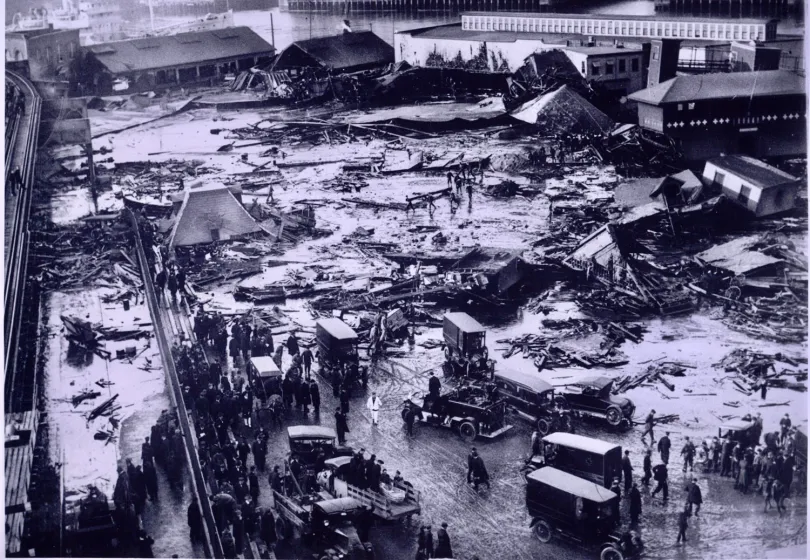
Within minutes, Commercial Street and the surrounding area were almost unrecognizable.
Homes and other structures had been damaged or destroyed. Horses, wagons and people were trapped. Parts of the neighborhood were covered by several feet of molasses.
Rescuers arrived quickly, including more than 100 sailors from the USS Nantucket. But reaching victims presented an unusual problem: rescuers themselves had to struggle through the sticky flood.
Every movement was difficult.
Molasses clung to clothing and equipment. Debris was scattered throughout the area. Victims could be hidden beneath wreckage or submerged in the dark liquid.
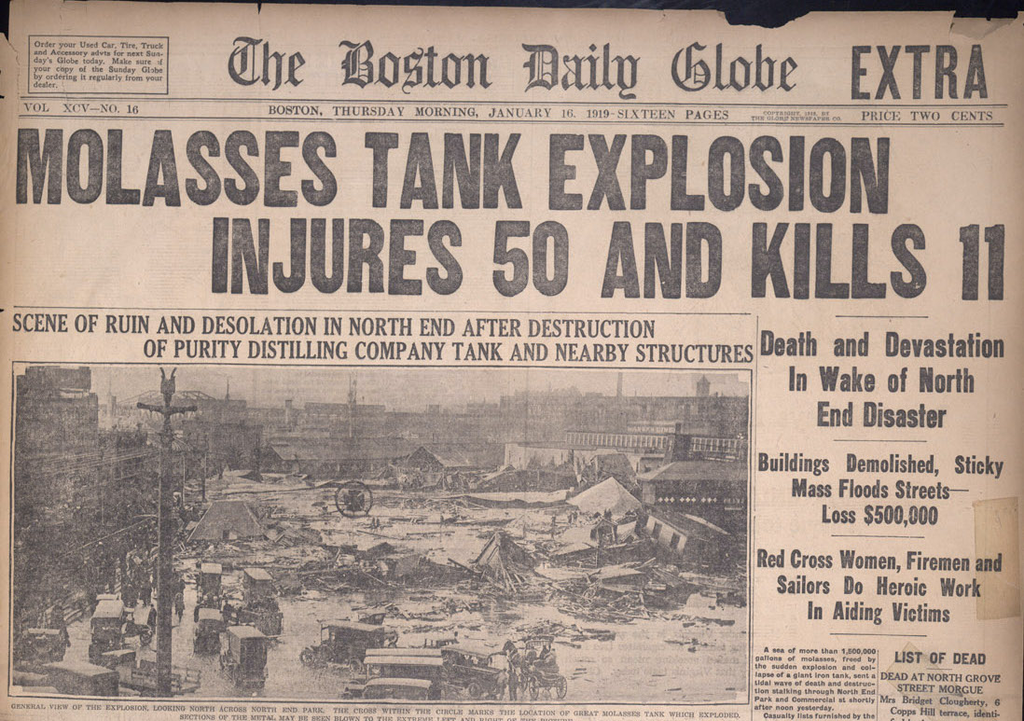
The disaster ultimately killed 21 people and injured approximately 150 others.
Some victims were not recovered until days later.
Why Did the Tank Collapse?
Almost immediately, people wanted to know how something so bizarre could have happened.
The company initially argued that sabotage may have been responsible. The idea wasn’t entirely unimaginable in 1919, when bombings and political violence had created widespread fear of anarchist attacks.
But investigators found no evidence that explosives caused the disaster.
Instead, attention turned toward the tank itself.
Evidence presented during the extensive litigation that followed pointed toward structural weakness. The tank had reportedly leaked before the catastrophe, and later engineering research concluded that serious problems existed with its construction.
A modern engineering analysis found that the tank’s steel walls were too thin for the enormous load they were expected to contain. Smithsonian has reported that subsequent research concluded portions of the tank were approximately 50 percent too thin to safely hold the enormous quantity of molasses stored inside.
The court-appointed auditor eventually concluded that structural weakness—not sabotage—caused the collapse.
The company was held responsible.
A Disaster That Changed the Rules
The consequences reached beyond the families and neighborhood directly affected.
The litigation lasted years and involved thousands of witnesses. More than 100 claims were eventually settled, with the company paying substantial damages.
But the disaster also demonstrated what could happen when enormous industrial structures were built without adequate engineering oversight.
Massachusetts eventually began regulating large aboveground storage tanks in the aftermath of the tragedy. Today, the state’s Department of Fire Services says aboveground tanks larger than 10,000 gallons that store fluids other than water require permits and inspections. The agency specifically traces the history of that regulation back to the 1919 Molasses Flood.
Cleaning Up Millions of Gallons of Molasses
Stopping the immediate emergency was only the beginning.
The neighborhood still had to be cleaned.
Crews used salt water to wash away the molasses and spread sand to help absorb it. The cleanup continued for weeks.
But containing the mess proved nearly impossible.
Workers, rescuers and curious spectators walked through the affected streets and carried the sticky substance elsewhere on their shoes and clothing. Molasses found its way onto streetcars and into other parts of Boston.
For years afterward, stories circulated that the North End continued to smell like molasses during warm weather.
Whether every later account of that lingering smell was literal or became part of Boston folklore, the disaster itself was very real.
More Than a Strange Piece of History
More than a century later, the Great Boston Molasses Flood remains memorable partly because it sounds impossible.
A flood made of molasses seems like the setup to a joke or an exaggerated story passed down through generations.
But behind the unusual name were real people caught in an industrial catastrophe.
Twenty-one people went to work, walked through their neighborhood or went about their ordinary routines on January 15, 1919, and never came home.
The disaster became a lesson in engineering, corporate responsibility and the importance of safety standards.
And it left Boston with one of the strangest—and most tragic—chapters in American history.
Sources
The Boston Public Library confirms the 2.3-million-gallon volume, estimated 15-foot/35-mph wave, 21 deaths, roughly 150 injuries, structural-failure finding and resulting changes to construction codes. Massachusetts also directly connects today’s regulation of large aboveground storage tanks with the 1919 disaster.
Boston Public Library — “Boston’s Great Molasses Flood”
Smithsonian Magazine — “Without Warning, Molasses Surged Over Boston 100 Years Ago”
Smithsonian Magazine — “The Sticky Science Behind the Deadly Boston Molasses Disaster”
Massachusetts Department of Fire Services — History of Aboveground Storage Tank Regulation
Leave a Reply